
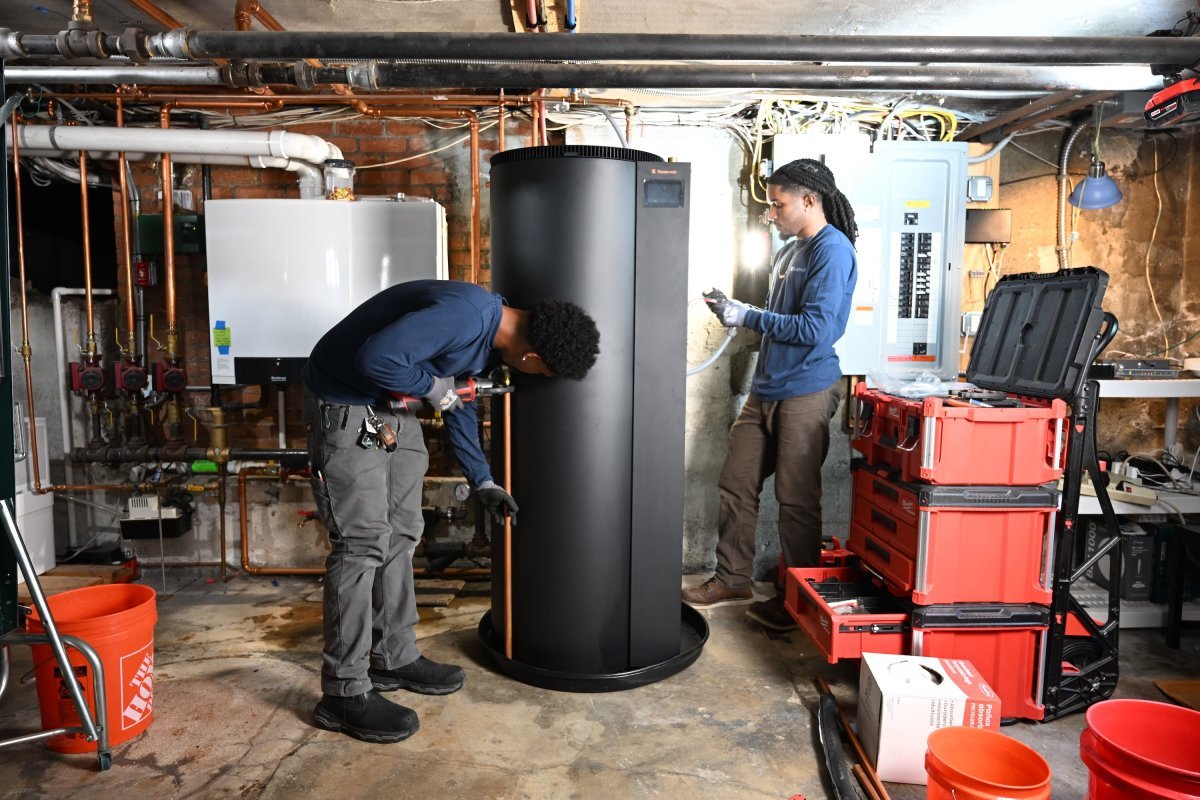
BOSTON, MA — Reservoir, a climate technology startup focused on reinventing the residential water heater, has announced a successful 8 million dollar seed funding round led by Asymmetric Capital Partners. Co-founded by former Formlabs executive Luke Winston-Almanzar alongside Gabriel Parisi-Amon and Jake Felser, the company aims to transform a traditionally overlooked home appliance into an intelligent energy storage and protection hub. Standard water heaters currently account for approximately 18 percent of a household’s total energy expenditure and remain a leading cause of residential water damage. Reservoir’s solution utilizes ultra-efficient heat pump technology coupled with machine learning to predict hot water demand, allowing the unit to store energy when electricity prices are lowest. By integrating features such as ultrasonic leak detection and grid-response capabilities, Reservoir seeks to offer a product that appeals to both homeowners and utility providers. The startup has already deployed roughly 100 units in the Boston area and plans to reach a megawatt-scale capacity of 1,000 installations by the end of next year.
Scaling Installation and Infrastructure in New England
Reservoir intends to use its newly acquired eight million dollars to expand its installation footprint significantly within the Boston metropolitan area. Led by Asymmetric Capital Partners with contributions from Founder Collective and MCJ, this seed funding round provides the capital necessary to move beyond the startup’s initial pilot phase. To date, the company has successfully installed approximately 100 units, but it has set an ambitious target of reaching 1,000 installations by the conclusion of next year. Reaching this milestone is critical for the company’s broader strategy, as it would represent a megawatt-scale capacity of energy storage. By focusing on a specific regional market initially, the founders hope to demonstrate the viability of their integrated service and hardware model before expanding to other high-demand territories.
Advanced Machine Learning and Thermal Efficiency
The proprietary Reservoir system utilizes integrated heat pump technology to achieve efficiency levels that are nearly four times higher than standard electric heaters. While traditional water heaters function as passive devices that only react to temperature drops within the tank, Reservoir’s units are equipped with intelligence that allows them to anticipate user needs. During the first month of operation, the device monitors household water usage patterns to train a custom machine learning model. Once the training period is complete, the unit optimizes its heating cycles to run during periods when electricity is most affordable and demand is lowest. This proactive approach ensures that homeowners always have an ample supply of hot water while simultaneously reducing the total energy consumption required for thermal maintenance.
Comprehensive Residential Protection and Connectivity
Beyond thermal efficiency, the Reservoir system integrates ultrasonic flow sensors to provide continuous whole-home plumbing leak detection through a dedicated mobile application. Recognizing that water heaters are a primary source of residential property damage, the founders prioritized safety and diagnostic features that distinguish their product from commodified appliances. The high-end Max version of the hardware includes a recirculation valve for near-instant hot water delivery and a specialized mixing valve designed to prevent pipes from freezing during extreme cold snaps. Furthermore, the unit features a Party Mode setting, accessible via a built-in touchscreen or smartphone, which enables a standard 50-gallon tank to deliver up to 150 gallons of hot water by adjusting internal thermal parameters and flow management during periods of peak guest demand.
Promoting Grid Stability Through Demand Response
Reservoir aims to alleviate strain on the electrical grid by aggregating its fleet of water heaters to participate in utility demand response programs. Because the units can store energy in the form of hot water, they essentially function as a distributed battery network across a neighborhood. When electricity demand peaks, utilities are often forced to rely on expensive and carbon-intensive peaker plants; however, Reservoir can signal its units to avoid tapping the grid during these critical windows without impacting the consumer’s hot water supply. The company is exploring ways to pass the payments received from these demand response programs back to the customers, effectively lowering the long-term cost of ownership while providing a valuable service to grid operators seeking to stabilize local power distribution.
Overcoming Distribution Hurdles with Vertical Integration
To accelerate the adoption of its new technology, Reservoir has taken the unconventional step of launching its own plumbing company to handle sales and installations. Chief Executive Officer Luke Winston-Almanzar noted that this decision was influenced by his previous experience at Formlabs, where he observed that traditional distributors were often hesitant to embrace innovative or complex hardware. By controlling the installation process directly, Reservoir can ensure a high level of service quality and simplify the purchasing experience for homeowners who typically rely on whatever a third-party plumber has in stock. This vertical integration allows the startup to maintain direct relationships with its users, gather better performance data, and bypass the legacy supply chains that frequently slow the transition to more sustainable home technologies.
Consumer Economics and Long Term Energy Savings
The economic profile of Reservoir’s hardware is designed to compete directly with existing high-end heat pump models while offering significantly lower operating costs. The base Core model is priced at $5,000 and the Max version at $6,500, with both figures including the full cost of installation. When accounting for local incentives, such as the $1,050 rebate available to Massachusetts residents, the final price becomes highly competitive with traditional systems. Reservoir estimates that typical homeowners in the Boston region can save up to $1,000 annually on energy expenditures compared to using electric or natural gas alternatives. Given that the company provides a 10-year warranty, most users are expected to reach a financial breakeven point well before the unit requires replacement, making the transition to smart water heating a viable investment.