
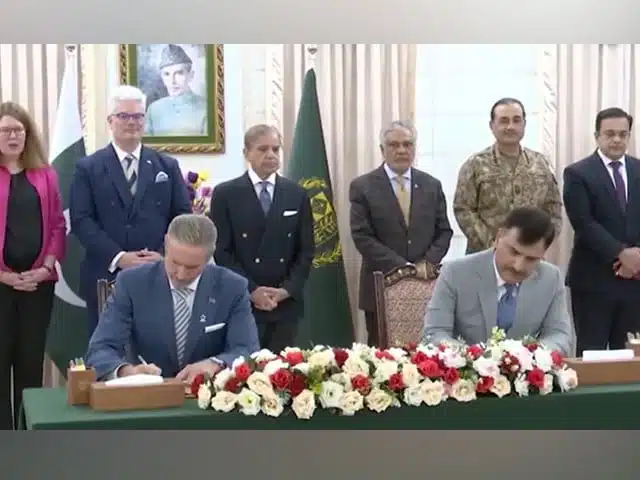
Pakistan, US Sign $500M MoU to Advance Critical Minerals Sector – 2025
In a major leap for Pakistan’s mining and mineral development ambitions, the country has signed a landmark $500 million Memorandum of Understanding (MoU) with the United States. The agreement aims to strengthen bilateral cooperation in the exploration, processing, and value addition of critical minerals.
Strategic Partnership in Motion
On September 8, 2025, representatives from United States Strategic Metals (USSM) and global infrastructure firm Mota-Engil arrived in Islamabad for high-level meetings. The delegation, led by Pakistan’s Frontier Works Organisation (FWO)—the nation’s largest miner of strategic minerals—met with senior officials, including the Prime Minister, Army Chief, and key federal ministers.
The result: a comprehensive MoU with USSM that establishes a framework for collaboration across the entire critical minerals value chain—ranging from extraction and export to potential local refining and processing. Targeted minerals include antimony, copper, gold, tungsten, and rare earth elements (REEs).
Development Roadmap and Investment Strategy
This agreement marks the start of a significant investment phase. Initial actions include:
- Identifying minerals ready for immediate export
- Assembling specialized teams to evaluate resource potential
- Planning infrastructure for exploration, processing, and logistics
USSM also announced plans to build a poly-metallic refinery in Pakistan, capable of producing both intermediate and finished mineral products for export—primarily to meet growing demand in the U.S. market.
The project is expected to create jobs, transfer technology, and catalyze sustainable mining practices, while contributing to the growth of Pakistan’s mineral economy.
Sustainability and Innovation at the Core
A key highlight of the MoU is its emphasis on environmental responsibility, sustainable development, and profitable mining practices—reflecting global ESG (Environmental, Social, and Governance) standards.
The agreement also introduces innovative funding mechanisms, including the tokenization of critical minerals. This blockchain-based financing approach is designed to:
- Attract global investors
- Improve market liquidity
- Ensure transparency and traceability in mineral supply chains
Bilateral and Regional Significance
US Chargé d’Affaires Natalie Baker described the signing as a milestone in strengthening US-Pakistan economic ties, calling it a mutually beneficial move.
The initiative also aligns with the broader U.S. strategy to diversify critical mineral supply chains, reducing dependence on traditional sources amid evolving global geopolitics.
This deal follows a recent uptick in bilateral engagements—including a US-Pakistan trade agreement and discussions on hydrocarbon development—reflecting a broader economic cooperation framework.
Unlocking Economic Potential
With vast mineral resources—particularly in Balochistan—Pakistan is increasingly drawing interest from international investors. Projects like Reko Diq, known for its massive copper-gold reserves, offer strong potential for integrated extraction, processing, and export.
Combined with the $500 million investment, Pakistan’s push for value-added mineral exports, refinery development, and digital financing models could significantly boost GDP and foreign exchange earnings.
Looking Ahead
This MoU signals a transformative shift—from raw resource extraction to a value-driven, transparent, and sustainable mining sector. To ensure long-term benefits, experts emphasize the importance of:
- Transparent project implementation
- Local workforce training
- Environmentally responsible operations
With billions in potential mineral wealth at stake, the world will be watching how Pakistan navigates this critical opportunity—positioning itself as a hub for critical minerals, advanced processing, and global economic integration.
